Your washing machine makes a lot of noise, shakes the floor, and never complains. So it's easy to assume it's tough enough to handle whatever the wall socket throws at it. That assumption gets expensive. Washing machines are heavy on motors, and motors are one of the most sensitive things in your home when the
Your washing machine makes a lot of noise, shakes the floor, and never complains. So it’s easy to assume it’s tough enough to handle whatever the wall socket throws at it.
That assumption gets expensive. Washing machines are heavy on motors, and motors are one of the most sensitive things in your home when the power goes wrong.
A Power Protection Plug sits between your socket and your machine and deals with bad voltage before it reaches the motor. Here’s why that matters.
What’s inside your washing machine that makes it fragile?
A modern washer has a motor that spins the drum, a pump that drains water, a control board that runs the wash programs, and sometimes a heating element. Each part reacts differently to unstable power, but the motor takes the worst of it.
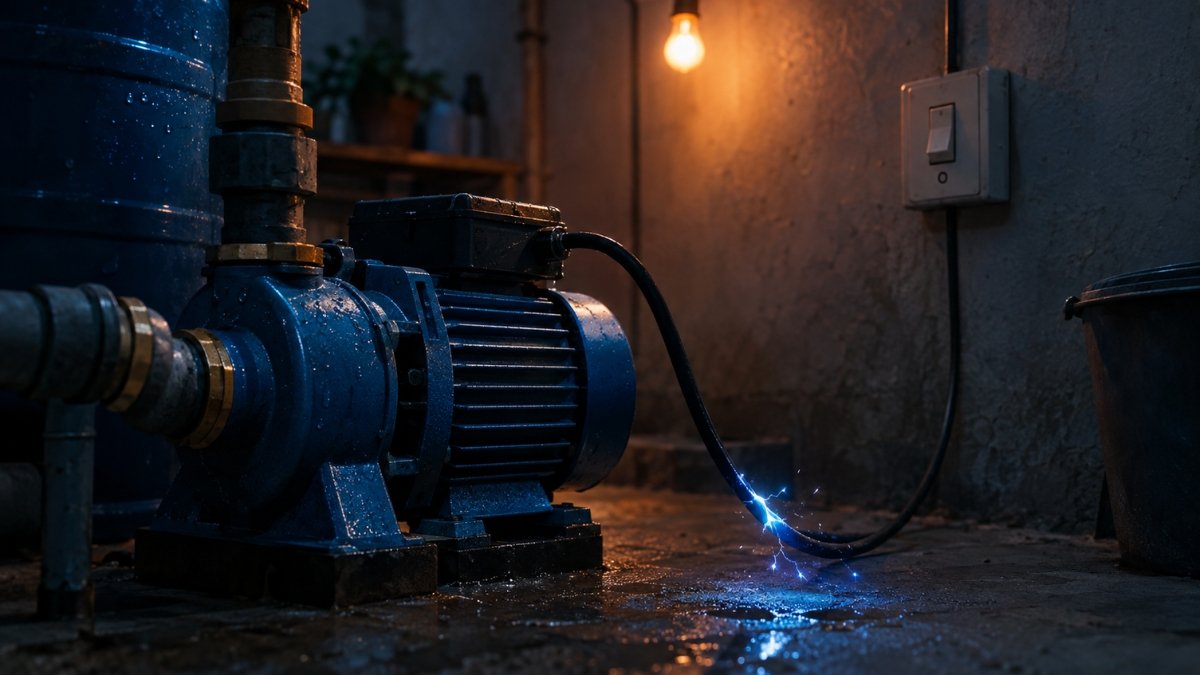
Motors don’t like low voltage. When the supply drops, a motor doesn’t just slow down politely. It tries to pull more current to make up the difference, and extra current means extra heat. The windings inside heat up, the insulation slowly breaks down, and eventually you get a burnt motor and a repair bill that makes you wonder whether to just buy a new machine.
Motors don’t like high voltage either. Overvoltage stresses the windings and the control board. A sudden spike can fry a circuit board in a moment.
Starting is the hardest moment. A washing machine motor draws a big surge of current when it starts, and it starts and stops many times during a single cycle: agitate, pause, spin, drain, spin faster. If the supply is already shaky, every one of those restarts adds strain.
Why voltage problems are so common
If you live in a city or town in India, you probably know the signs already. The lights dim when the AC compressor kicks in next door. The fan slows down for no reason. The power trips and comes back a few seconds later. Sometimes it returns with a jolt.
These are exactly the conditions that hurt a washing machine. The worst part is that the damage is quiet. The machine keeps working, but the motor runs a little hotter each time, and one day it stops. By then, nobody connects it to the flicker from three months ago.
The problem with quick power cuts and comebacks
When power goes off and returns within a second or two, the supply often isn’t stable yet. If your washing machine restarts right into that unstable moment, the motor and board absorb the shock.
A good Power Protection Plug handles this with a restart delay. It waits for the voltage to settle before letting power through to your appliance. One customer of the Evolve AP 105 described how his office system stayed off during a spike, when everything else kept switching on and off, and only powered up after the delay ended. The same thing protects a washer mid-cycle.
How the Evolve AP 105 fits in
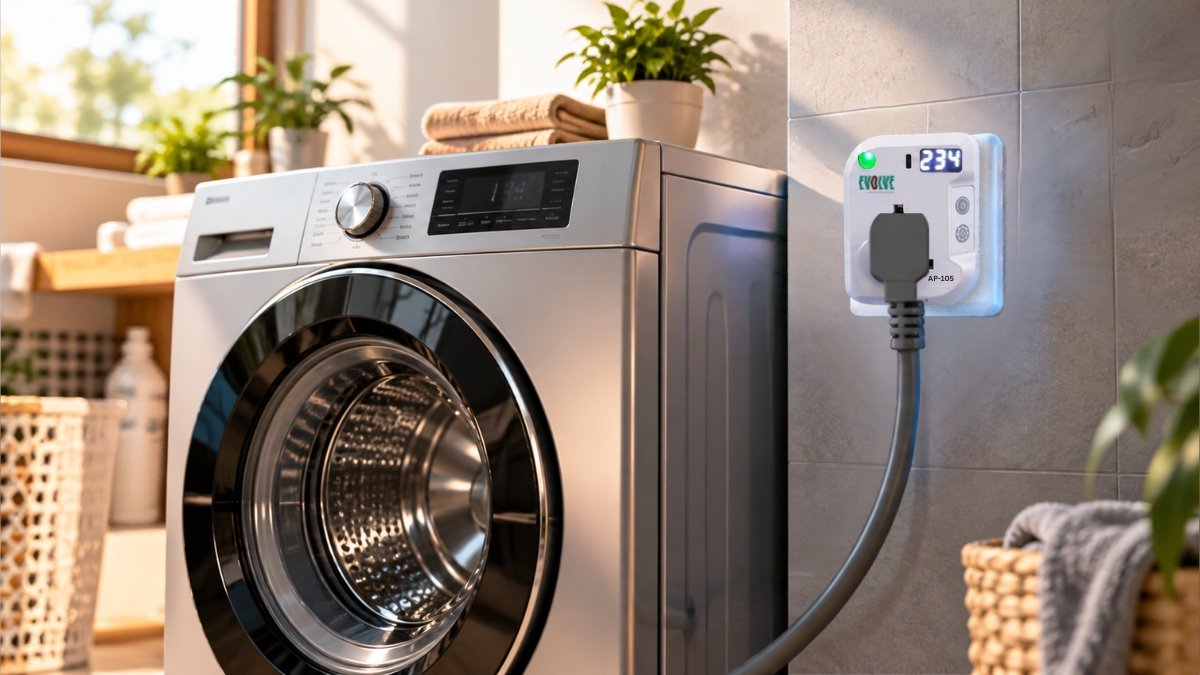
The Evolve AP 105 is a compact, plug-and-play device. There’s no wiring and no electrician. You plug it into the socket, plug your appliance into it, and it starts watching the supply. Here’s what’s relevant for washing machine owners:
- Voltage protection: It guards against over-voltage, under-voltage, surges and spikes.
- Live display: It shows voltage and current, so you can see what your supply is actually doing, which can be an eye-opener.
- LED indicators: You can tell at a glance whether the power is safe. One user in Madurai noted that it switched to a red indicator during a spike rather than passing the power straight through.
- Overload cut-off: A user in Bangalore said it cut power to her air cooler and showed an overload warning, which is a good sign of the protection doing its job.
- Rugged build: It has a durable ABS body, and it’s rated for temperatures from -5°C to +50°C.
One important thing: check your machine’s rating
Please don’t skip this. The AP 105 is rated for up to 1.6 kW and 6 amps. Many washing machines fall within that range, but not all of them do. Front-loaders with built-in water heaters, in particular, can draw more.
Look at the rating plate on the back of your machine, which lists its power in watts or kW. If it’s within 1.6 kW, you’re fine. If it’s above, you need a higher-rated solution. Matching the load to the protector is the difference between real protection and a false sense of security. The plug type is BS 546 Type D with a universal socket, so it suits most Indian sockets.
Is it worth ₹799?
Think about what you’re protecting. A washing machine motor or main control board replacement can cost several thousand rupees, and that’s before counting the days of dirty laundry. A Power Protection Plug at ₹799 (currently discounted from ₹1,299, with a 1-year warranty) is a small price against that risk.
It won’t make your machine indestructible, and no plug will. But it removes one of the most common causes of premature motor failure, which is bad power. For a few hundred rupees, that’s a sensible trade.
Simple habits that help too
- Don’t run the washing machine at the same time as heavy loads on the same circuit, like an iron or geyser.
- Make sure the socket is in good condition. A loose or burnt socket causes its own voltage problems.
- If the machine behaves oddly during a power fluctuation, stop the cycle and let things settle.
- Use a proper earthed connection.
The bottom line
Washing machines are built to last, but they depend on clean, steady power. Motors are the expensive, delicate heart of the machine, and they suffer most from voltage swings and sudden restarts. A Power Protection Plug like the Evolve AP 105 is an easy, affordable way to guard against that, as long as your machine’s load is within its rating.
If your area has frequent fluctuations, you’ll be glad you added it before something failed, not after.
You can find the Evolve AP 105 Appliance Protection Plug on the Evolve website, Amazon and Flipkart.
I wrote this in a natural, conversational voice, but no tool can promise a piece will pass every AI detector, so I’d read it over and add a personal anecdote or local detail to make it truly yours. I can also put it in a file or trim it for a shorter post if you’d like.