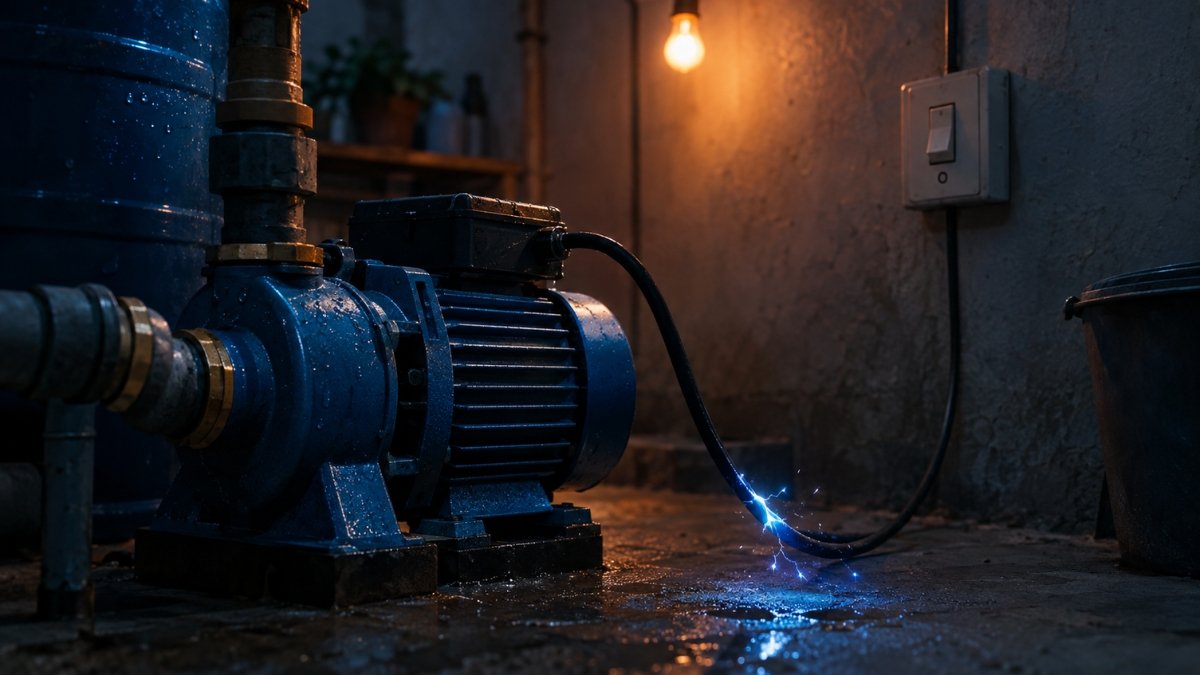
If you've ever watched your lights flicker during a storm, or heard your refrigerator hum a little louder than usual right before it switches off, you already know what a voltage fluctuation feels like. What you might not know is what's happening electrically in that moment, or how a small device sitting between your appliance
If you’ve ever watched your lights flicker during a storm, or heard your refrigerator hum a little louder than usual right before it switches off, you already know what a voltage fluctuation feels like. What you might not know is what’s happening electrically in that moment, or how a small device sitting between your appliance and the wall socket can quietly step in and stop the damage before it starts.
That device is a Power Protection Plug, and while it looks like a simple accessory, there’s a surprising amount of engineering packed into that compact plastic shell. Let’s walk through what actually happens inside one, from the moment unstable power hits it to the moment it decides whether your TV or fridge is safe to keep running.
Why Voltage Fluctuations Happen in the First Place
Indian power grids, especially in semi-urban and rural areas, aren’t always perfectly stable. Voltage can swing for a number of reasons:
- Sudden load changes when heavy machinery, pumps, or air conditioners switch on nearby
- Lightning strikes or transformer faults during storms
- Overloaded local transformers during peak usage hours (early evenings are notorious for this)
- Poor grid infrastructure in certain regions, where supply voltage can drift well outside the ideal 220-230V range
None of this is something you can control from inside your home. What you can control is what happens to your appliances when it occurs, and that’s exactly where a Power Protection Plug earns its keep.
Step One: Constant Voltage Monitoring
A Power Protection Plug doesn’t wait for something to go wrong. It’s always watching. Inside the device, a small monitoring circuit continuously samples the incoming AC voltage, checking it against a safe operating band, typically something like 160V to 280V depending on the design.
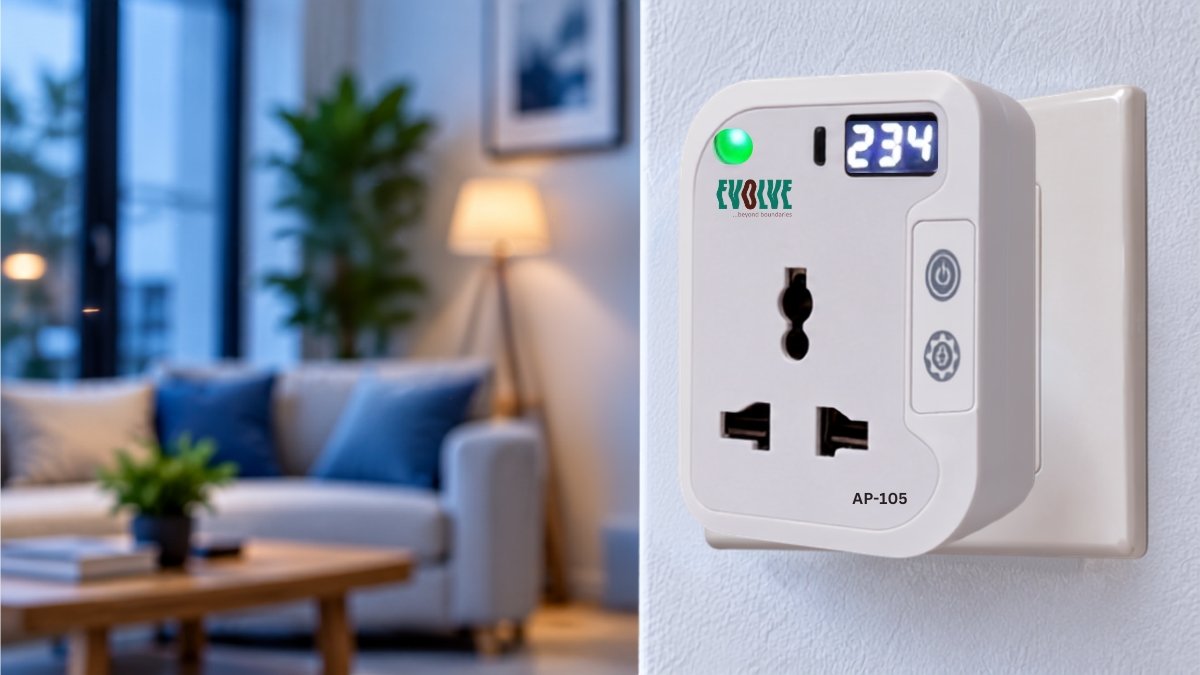
This isn’t a one-time check at power-on. It’s a live, ongoing measurement, updated many times per second, because voltage swings can happen in a fraction of a second. A device like the Evolve AP 105, for instance, is built to handle an extended voltage range of 110V to 600V, which gives it enough headroom to catch both mild dips and fairly severe surges before they ever reach your appliance.
Step Two: Recognising an Abnormal Condition
Once the plug detects that incoming voltage has crossed outside the safe threshold, whether it’s a slow brownout during peak hours or a sharp spike from a lightning-related surge, its internal logic classifies the event. Broadly, these fall into a few categories:
- Undervoltage (brownout): Voltage drops too low, which can cause motors in fridges, pumps, and ACs to overheat while struggling to run
- Overvoltage (surge): Voltage climbs above safe limits, risking burnt circuit boards and damaged compressors
- Transient spikes: Very brief but intense voltage jumps, often from lightning or grid switching, that can fry sensitive electronics in microseconds
Good indicators matter here. Many plugs, including the AP 105, use simple LED colour changes to tell you what’s happening in real time. Users have reported that the light shifts to a warning colour the instant a spike is detected, giving a visual confirmation that the device is actively working rather than just sitting there.
Step Three: Cutting the Power Before Damage Occurs
This is the part that actually protects your appliance. The moment the internal circuit confirms voltage has moved outside the safe zone, it triggers a relay or switching mechanism that disconnects the output socket from the incoming supply. Your appliance is instantly isolated from the unstable power, so it simply loses power for a moment rather than absorbing a surge or straining through a brownout.
This is different from a basic surge protector, which mainly absorbs excess energy from a single spike. A Power Protection Plug actively cuts the circuit and keeps it cut until conditions stabilise.
Step Four: The Restart Delay
Here’s a detail that often gets overlooked but matters a lot in practice. When power returns to normal, the plug doesn’t immediately reconnect your appliance. Instead, it waits, usually a few minutes, before restoring the connection.
Why does this matter? Because raw power supply after an outage is often unstable itself, with voltage spikes as the grid re-stabilises. This built-in restart delay lets the supply settle fully before your compressor, motor, or electronics are exposed to it again. It’s a small design choice, but it’s often the difference between an appliance that lasts years longer and one that quietly degrades after every fluctuation.
Step Five: Handling Overload, Not Just Voltage
Voltage isn’t the only risk. Plugging in too many devices, or running one that draws more current than the plug is rated for, can also cause damage. That’s why a well-designed Power Protection Plug also monitors current draw and will cut power if the load exceeds its rated capacity (commonly around 6 Amps or up to 1.6 kW for compact home units). This protects both the connected appliance and the plug itself from overheating.
Why This Matters for Everyday Appliances
Refrigerators, TVs, computers, routers, and washing machines are all sensitive to power quality in different ways. Compressors don’t like brownouts. Circuit boards don’t like spikes. Motors don’t like being switched on and off rapidly during unstable supply. A Power Protection Plug essentially puts a buffer between the unpredictability of your local grid and the equipment you rely on every day, without needing any installation or wiring changes. You plug it into the wall, plug your appliance into it, and it does the monitoring in the background.
Final Thoughts
Voltage fluctuations aren’t going away anytime soon, especially in areas where grid infrastructure is still catching up with demand. But the appliances in your home don’t have to bear the brunt of that instability. A Power Protection Plug works through a fairly elegant sequence, constant monitoring, fast detection, instant disconnection, and a cautious restart to keep your devices running safely no matter what the grid throws at them.
It’s not a flashy piece of technology, but it’s one of those quiet safeguards that only gets noticed when it’s missing.