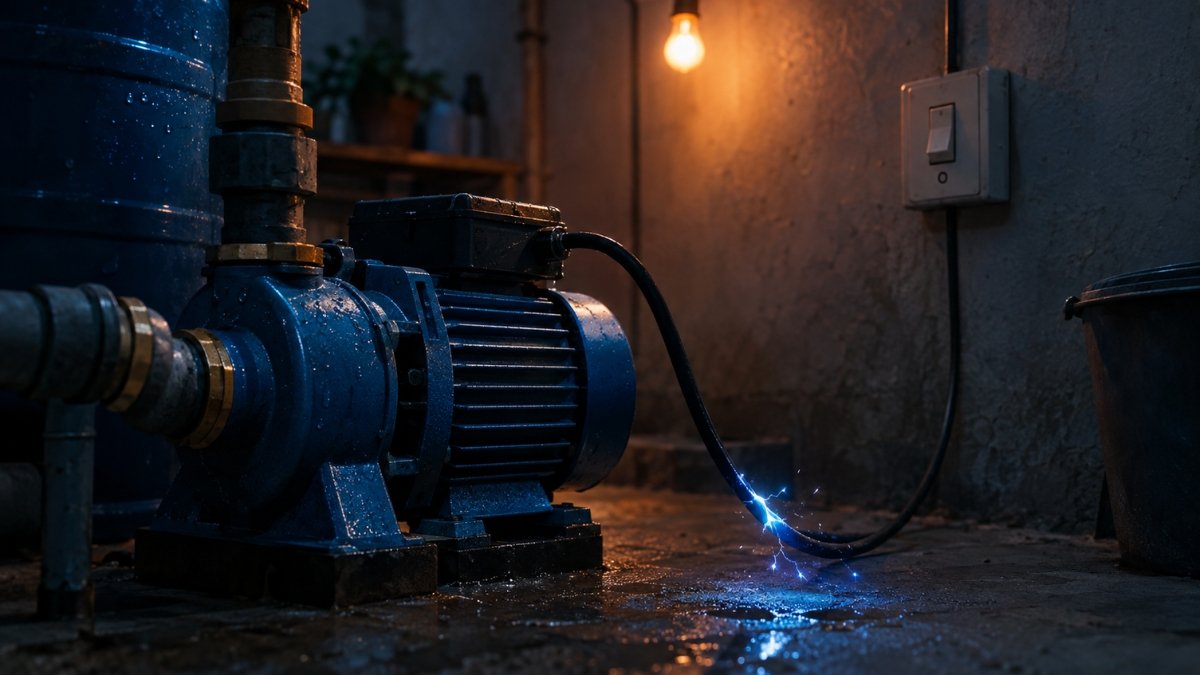
Picture this. It's the middle of May. The summer has been long, the groundwater table has dropped, and you've been running your borewell pump a little longer than usual each morning just to fill the overhead tank. One day, you switch on the pump, hear it start up, and walk away. Thirty minutes later, you
Picture this. It’s the middle of May. The summer has been long, the groundwater table has dropped, and you’ve been running your borewell pump a little longer than usual each morning just to fill the overhead tank. One day, you switch on the pump, hear it start up, and walk away. Thirty minutes later, you check the tap, but nothing. You go back to the motor. It’s silent. The thermal cutout has tripped, or worse, it hasn’t, and the motor has been running dry for the last half hour.
You call the pump service technician. He takes one look and says, “Motor burnt. Winding gone.”
That’s not a freak accident. It’s one of the most common and most preventable pump failures in India. And the device that prevents it is called Dry Run Protection.
What Actually Happens When a Pump Runs Dry?
To understand why Dry Run Protection matters, you need to understand what a submersible or surface pump is actually doing when it runs.
A pump doesn’t just move water. It relies on water for two critical functions that happen simultaneously:
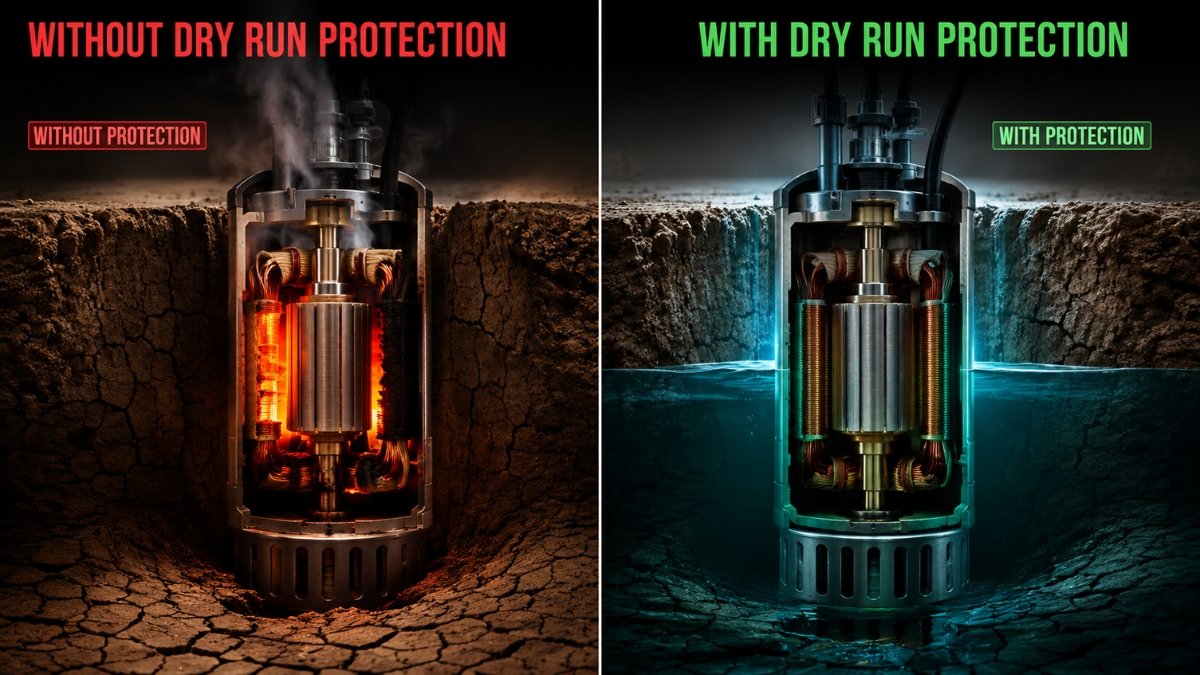
Cooling: The motor generates heat during operation. In a submersible borewell pump, the water flowing past the motor body carries that heat away continuously. Without water movement, there’s nothing to absorb the heat. Winding temperatures can climb from a normal 60°C to dangerous levels in under a minute.
Lubrication: The pump’s internal seals and bearings are designed to operate with water as the lubricating medium. When water disappears, metal meets metal. Friction damage to the impeller, seals, and shaft bearings begins within seconds of dry running.
When both fail simultaneously, which is exactly what happens during a dry run, the damage is rapid and severe. Studies and field data from Indian agricultural pump setups consistently show that a submersible pump can sustain irreversible damage in as little as 2 to 5 minutes of running completely dry.
The problem is compounded in Indian conditions. Borewell water tables fluctuate seasonally, dropping significantly in March through June across Tamil Nadu, Karnataka, Andhra Pradesh, and most of peninsular India. A borewell that delivers water reliably in January may run low by May. And a Water Pump Controller that doesn’t account for this is protecting you in only one season.
Why a Basic Starter Isn’t Enough
Most borewell pump setups in India run on a basic DOL Motor Starter, a contactor, an overload relay, and start/stop buttons. The overload relay does protect against sustained overcurrent, but it’s not the same as Dry Run Protection.
Here’s the gap: when a pump runs dry, the current drawn by the motor actually drops, not rises. The impeller is spinning freely with no load, so there’s less resistance and less current. A standard thermal overload relay is looking for excess current, and it never sees it. The motor runs on and on, overheating, until a winding fails.
This is the fundamental limitation of a basic starter for borewell applications. It protects against overload, a load problem. It doesn’t protect against a dry run, a no-load problem. These are two different failure modes, and they require two different protection mechanisms.
A proper Automatic Pump Control System with built-in Dry Run Protection specifically monitors for the condition where the pump is running with insufficient water, and responds appropriately, not by waiting for overcurrent, but by detecting the absence of water or the absence of expected flow load.
How Dry Run Protection Works
Modern Dry Run Protection systems use one or more of the following detection methods:
Current sensing: The controller monitors the motor’s current draw in real time. A pump running dry draws measurably less current than one pumping water under load. The controller detects this drop and trips the motor automatically.
Probe-based water level sensing: Electrode probes placed in the sump or source tank detect when the water level has dropped below a safe threshold. The controller cuts the motor before the source runs completely dry, preventing a dry run before it even starts.
Float switch integration: A float switch placed at the minimum safe water level in the sump triggers a direct cutoff signal when the water drops below that point.
The Evolve AP 101–103 Domestic Water Management System and the ST 301 / ST 302 Three Phase Pump Protector (DOL) both incorporate intelligent Dry Run Protection systems, the AP 10x series for single-phase surface pumps and the ST 30x series for 3-phase borewell and submersible pump applications.
Evolve’s Dry Run Protection: What It Does in Practice
In the AP 101–103 (Single-Phase Surface Pumps)
The AP 10x Series is designed for single-phase surface pumps used in domestic water management, sump-to-overhead-tank, inline level control, and pressure booster setups. Its Intelligent Dry Run Protection monitors the water source continuously. The moment conditions fall below the safe threshold, the pump stops automatically before the motor can overheat.
The system also includes Auto and Manual control modes, so when water returns to the source, the pump can restart automatically without you having to manually reset anything. LED status indicators show you the pump’s condition at a glance.
Operating range: 140V to 320V, handling the real-world voltage swings in the Indian domestic supply without complaint.
Suitable for pumps up to 1.5 HP / 1 kW.
In the ST 301 / ST 302 (Three-Phase Borewell and Submersible Pumps)
For 3-phase borewell and submersible pumps- the more powerful, more expensive, and harder-to-service pump motors used in agricultural irrigation and commercial water supply- the ST 30x Series delivers Dry Run Protection alongside a full suite of motor protection features:
- SPP (Single Phasing Prevention) trips the motor if any of the three phases drops out, one of the most destructive faults in 3-phase pump systems
- Dry Run Protection monitors water availability and cuts the motor before damage occurs
- Overload and fault protection protect against excess current from mechanical blockages or jams
- High and Low Voltage Protection handles supply swings across its 270V to 520V operating range
- Timer and Cyclic Operation, for scheduled irrigation runs without manual switching
- Manual Bypass Option allows direct motor operation even if the controller module needs servicing, so your pump is never completely stranded
- Float Switch Compatibility (ST 302) integrates with tank-level float switches for full level-based automated control
Suitable for pumps up to 20 HP / 15 kW, with a current rating of 18 to 32 Amps, covering the full range of borewell pump motor sizes used in Indian agricultural and commercial setups.
The Seasonal Reality: Why Borewell Owners Need This More Than Anyone
Dry Run Protection matters year-round. But for borewell owners, it matters most in the months when groundwater levels are at their lowest, typically February through June across most of India.
During this period, a borewell that has reliably delivered water for years may start running low. The pump’s intake, positioned at a fixed depth, can find itself pulling from a depleted zone. Without protection, the pump runs on regardless, and the motor pays the price.
The irony is that the months when borewell water is most stressed- summer- are also the months when you can least afford a pump failure. Water demand is highest. Repair technicians are busiest. Lead times for motor rewinding or replacement are the longest.
A Water Pump Controller with Dry Run Protection installed before the summer season begins is the difference between a system that manages itself through the stress period and one that fails at the worst possible time.
What Does Motor Repair or Replacement Actually Cost?
Let’s be direct about the numbers, because this is where the value of Dry Run Protection becomes undeniable.
| Damage Type | Typical Cost |
| Motor winding rewind (single-phase, 1–2 HP) | ₹2,500 – ₹6,000 |
| Motor replacement (single-phase, 1.5 HP) | ₹5,000 – ₹10,000 |
| Submersible pump pulled from the borewell (labour) | ₹2,000 – ₹5,000 |
| Motor rewind/replacement (3-phase, 3–5 HP) | ₹8,000 – ₹20,000 |
| Complete submersible pump replacement (3-phase, 5 HP) | ₹15,000 – ₹40,000 |
These are repair costs. They don’t account for the downtime, the days without water supply, the irrigation cycles missed, the crop stress during a dry run failure in peak summer.
The Evolve AP 101–103 and ST 301 / ST 302 cost a fraction of any entry in that table. And unlike a motor, they need no servicing, carry a one-year warranty, and continue protecting your pump every single operating cycle.
5 Signs Your Pump Setup Doesn’t Have Adequate Dry Run Protection
- You’ve had a motor burnout with no clear electrical cause; dry run is the most likely culprit
- Your starter is a basic contactor-overload relay setup; no dry run detection is built in
- Your borewell is in an area where water tables drop in summer, a high-risk period every year
- Your pump runs unattended, and no one is around to notice the motor humming without water
- You’ve replaced the motor more than once in the past 5 years. Repeated dry run damage is the most common reason for premature motor replacement
If any of these describe your situation, upgrading to a Water Pump Controller with built-in Dry Run Protection should be the next thing on your list, before the next summer arrives.
Choosing the Right Evolve Product for Your Setup
| Your Setup | Recommended Product |
| Single-phase surface pump, domestic use | AP 101 / AP 102 / AP 103 |
| Single-phase pump + need for timed operation | AP 103 (with RTC function) |
| 3-phase submersible or borewell pump | ST 301 |
| 3-phase pump + float switch/level control | ST 302 |
Both product lines share the same core commitment: protecting your motor from the faults that actually destroy pumps in Indian conditions, including Dry Run Protection, voltage range tolerance, and overload detection.
Final Thought
A borewell pump is not a cheap asset. The pump itself, the installation depth, the pipeline, and the control panel add up to a significant investment for any household or farm. And like any significant investment, it deserves protection proportional to what it costs to lose.
Dry Run Protection is that protection. Not a luxury feature, not an optional add-on, a fundamental safeguard against the most common mode of pump motor failure in India. It costs far less than one motor repair. It works every cycle, every season, whether you’re watching or not.
Install it before the damage happens. Because by the time you hear the silence where the pump should be humming, it’s already too late.