Last monsoon, a neighbour of mine lost his fridge compressor. There was no fire, no bang, and no dramatic sparks. The power just flickered a few times, came back too high for a second, and the compressor never started again. The repair bill was more than what a decent protection device costs. When he asked
Last monsoon, a neighbour of mine lost his fridge compressor. There was no fire, no bang, and no dramatic sparks. The power just flickered a few times, came back too high for a second, and the compressor never started again. The repair bill was more than what a decent protection device costs.
When he asked what could have saved it, I said a Power Protection Plug would have. Then he asked the question I hear all the time: “But the spike was only for a second. How would a plug even react that fast?”
That question is really about response time. It’s a phrase you’ll see on almost every protection device, and most people nod at it without knowing what it means. Let’s fix that.
So, what is response time?
Response time is the gap between something going wrong with your power and the device doing something about it.
Say the voltage jumps from 230V to 290V. That’s the problem. The moment your protection plug notices it and cuts the supply to your appliance is the reaction. The time between those two moments is the response time.
Think of a smoke alarm. A good one doesn’t wait for the whole room to fill with smoke. It goes off early. A Power Protection Plug works the same way, except the smoke is bad voltage and the alarm is a switch that disconnects your TV, fridge or laptop.
Why does a tiny delay matter?
Your appliances aren’t as tough as they look. Inside your TV, router or refrigerator, there are sensitive components that are built for a specific voltage range. Push them beyond that range and they don’t fail politely. They heat up, weaken, and die, sometimes right away and sometimes months later.
A long delay means your appliance takes the hit before the protector wakes up. A quick response means the appliance never sees the worst of it.
That’s the whole idea. The faster the plug reacts, the less punishment your device takes.
Not every power problem is the same
This is where people get confused, because “power problem” covers different things, and each one needs a different kind of reaction.
Spikes and surges. These are sudden, sharp jumps in voltage. They can come from lightning nearby, heavy machines switching on in the neighbourhood, or the grid coming back after an outage. They’re brief, but they’re brutal, and speed matters most here.
High voltage. The supply sits above normal for a while. Your appliance runs hot the whole time it lasts.
Low voltage. This is the sneaky one. Everything seems to work, but motors like the ones in your fridge, fan or air cooler strain to run and slowly wear out.
Overload. You’ve plugged in more than the device can safely handle, so the current climbs past the limit.
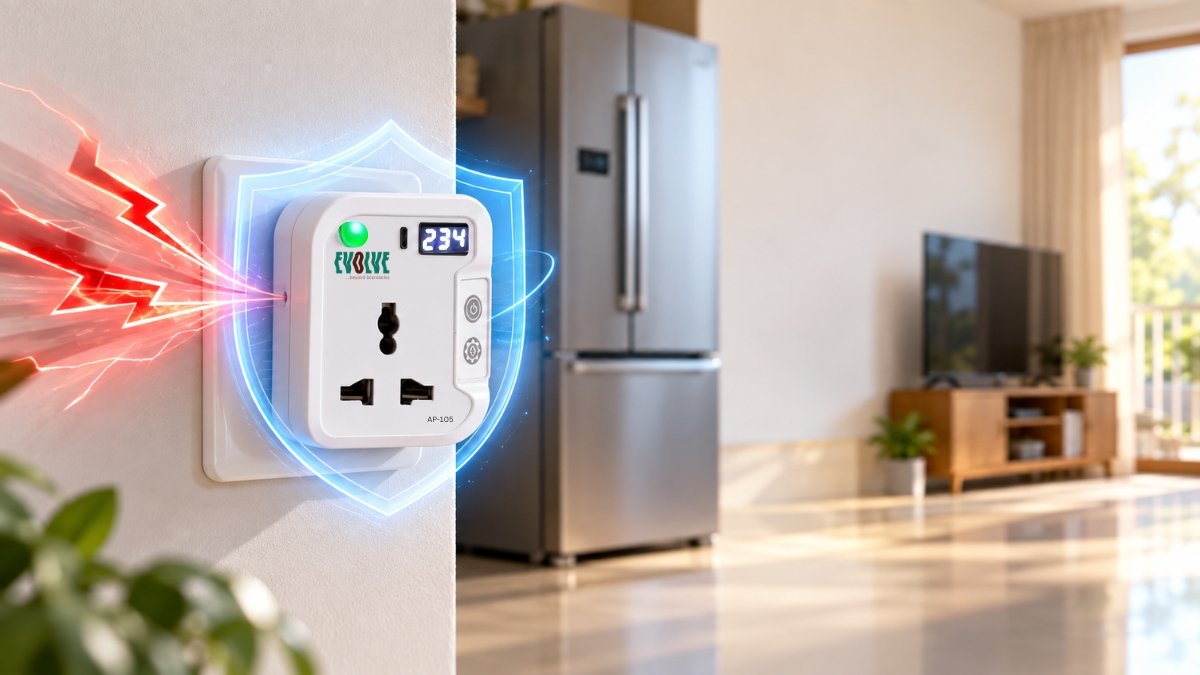
A good protection plug watches for all of these. The AP 105 from Evolve, for example, is built to guard against over and under voltage, surges, spikes and overload conditions. It also has a built-in voltage and current display, so you can see what your supply is actually doing instead of guessing.
The part people forget: the reconnect delay
Most people only think about how fast a plug cuts power. There’s a second half to the story that matters just as much, and that’s how the plug behaves when power comes back.
Right after an outage or a fluctuation, the supply is often unstable. It may bounce up and down for a few seconds before settling. If your appliance switches back on the instant power returns, it’s exposed to the worst moment of all.
That’s why a restart delay is such a useful feature. One AP 105 user from Chennai described it well. Voltage spiked in his office, and all the systems around him kept switching off and on repeatedly. His computer, connected through the plug, waited until the voltage stabilised and only powered on after the restart delay finished. Everything else was stuttering, and his system stayed calm.
This is especially important for anything with a compressor, like refrigerators and air conditioners. Rapid on and off cycles are exactly what kills them. A short pause before reconnecting gives the power time to settle and gives the compressor time to reset.
So when you judge a protection device, ask two things. How quickly does it react to danger, and how patiently does it wait before letting your appliance back in?
How do you know it’s actually working?
Here’s a small problem with protection devices: when they work perfectly, you notice nothing. That can feel strange, and honestly a bit suspicious.
This is why the indicators matter. Reviews of the AP 105 show it clearly. One user in Madurai noticed the light turn red during a sudden spike, and the plug held back the power instead of passing it straight through. Another in Bangalore had her air cooler cut off with an overload indication. Her first thought was that the device was faulty. Then she realised it had just saved the cooler from damage.
I like that second story because it captures something real. A protector that occasionally cuts your power isn’t broken. It’s doing the job you bought it for. The annoying moment is the whole point.
What should you look for when buying?
Response time is one factor among several, so here’s a practical checklist.
- Protection for more than just surges. Voltage cut-off on both the high and low side matters in most Indian homes, where the supply isn’t always steady.
- A reconnect delay. As we discussed, this protects fridges and ACs from the rough moment when power returns.
- A visible display or indicator. You should be able to see what’s happening without a multimeter.
- The right power rating. The AP 105 handles up to 1.6 kW at 6 Amps, which suits TVs, refrigerators, computers, routers, and small office equipment. It isn’t meant for a heavy air conditioner or geyser, so check the load before you plug something in.
- Compatibility. It uses a universal socket and supports BS 546 Type D pins, so it works with a wide range of plugs.
- Easy setup. If a device needs an electrician, most people won’t bother. The AP 105 is plug and play.
One honest note: if exact response-time figures matter to you, check the technical datasheet before buying instead of trusting any marketing line, mine included. Evolve provides one on the product page, and it’s worth a look.
Where a plug like this makes sense
The AP 105 covers a wide range of everyday setups:
- Televisions and home entertainment systems
- Refrigerators and kitchen appliances
- Computers and networking devices
- Office equipment
- Small industrial electronics
It’s compact at around 150 g, so it also works for travel or a rented flat where you can’t touch the wiring. It’s priced at ₹799 on the website with a 1-year warranty, which is small next to the cost of replacing a fridge compressor or a motherboard.
The takeaway
Response time sounds like a technical term, but the idea is simple. It’s how quickly your protection notices trouble and steps in before your appliance takes the damage, and how sensibly it lets power back in afterwards.
You can’t control what the grid does. Voltage will dip, spike and wobble no matter what. What you can control is whether your expensive appliances face that alone. A Power Protection Plug sits between your wall socket and your device and takes the hit for it.
My neighbour bought one for his new fridge the same week. He says it’s the cheapest thing he owns that he hopes never to think about.