If you grew up in an Indian household anytime before the 2010s, chances are there was a big, humming metal box sitting quietly next to the fridge or the TV. That was the voltage stabiliser, the unsung guardian of our appliances, doing its job for decades without much fuss. For a long time, it was
If you grew up in an Indian household anytime before the 2010s, chances are there was a big, humming metal box sitting quietly next to the fridge or the TV. That was the voltage stabiliser, the unsung guardian of our appliances, doing its job for decades without much fuss. For a long time, it was enough. It kept the fridge from tripping when the voltage sagged during a thunderstorm, and it stopped the old CRT television from frying its circuit board.
But here’s the thing: the appliances in our homes today are nothing like the ones from twenty years ago. And the stabilisers protecting them, in most homes, haven’t changed much at all. That mismatch is starting to show, in shorter appliance lifespans, in mysterious electronic failures, and in repair bills that shouldn’t really be happening.
Let’s talk about why.
The Old Stabiliser Was Built for a Different Era
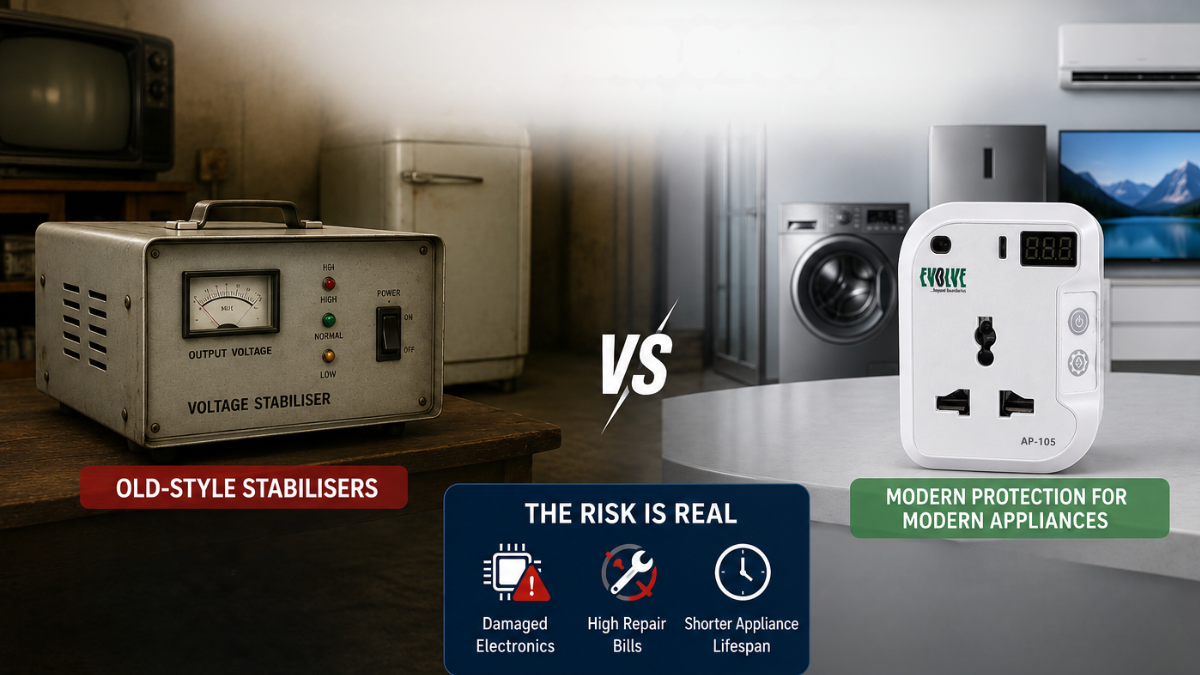
Traditional voltage stabilisers work on a fairly simple principle. They use a relay-based or servo-motor mechanism to step voltage up or down within a certain range, correcting it before it reaches your appliance. This worked well for older electronics because those devices had relatively simple internal components, basic transformers, motors, and circuits that could tolerate small swings in voltage without much drama.
Modern appliances are a completely different animal. Your refrigerator now has an inverter compressor. Your washing machine has a microprocessor controlling wash cycles. Your TV is essentially a small computer. Air conditioners, microwaves, mixers, and even ceiling fans increasingly run on sensitive electronic boards rather than purely mechanical parts. These components are precise, power-hungry in short bursts, and far less forgiving of electrical irregularities than anything from the stabiliser’s heyday.
Where Old-Style Stabilisers Fall Short
They React Too Slowly
Most conventional stabilisers, especially the relay type, correct voltage in noticeable steps rather than smoothly. There’s a small but real lag between when the voltage fluctuates and when the stabiliser catches up. For a 1990s refrigerator, that lag was harmless. For a modern inverter AC or a smart washing machine, that same lag can be enough to stress sensitive components every single time it happens, and it happens more often than most people realise, especially in areas with unstable grid supply.
They Don’t Handle Surges and Spikes
A voltage stabiliser is designed to manage gradual fluctuations, voltage that’s too low or too high over a sustained period. It is not built to handle sudden spikes, like the kind caused by lightning strikes, transformer faults, or even the appliance next door switching on and off. These spikes last for a fraction of a second but can do permanent damage to circuit boards. Old-style stabilisers simply weren’t designed with this threat in mind, because it wasn’t as big a concern when they were first built.
No Real Intelligence or Monitoring
Here’s something people don’t think about until it’s too late: a traditional stabiliser has no way of telling you anything is wrong. It doesn’t know if it’s overheating, if a fault has developed inside it, or if the supply voltage has gone dangerously out of range. It just keeps doing what it does, until one day, it doesn’t, and you find out only when your appliance stops working too.
One Size Rarely Fits the Modern Home
Many households still use a single large stabiliser for the entire house or for a handful of appliances. Multiple devices with very different power needs end up depending on one piece of ageing equipment. Today’s appliances, especially ones with inverter technology, have load patterns that are far more variable than older devices. A single generic stabiliser struggles to serve all of them equally well.
They Age Quietly, and Then Fail Loudly
Mechanical parts wear out. Relays in older stabilisers degrade with use, contacts get worn down, and internal components lose efficiency over the years. The frustrating part is that this degradation is invisible; the stabiliser looks the same, sounds the same, and nobody really checks it until an appliance gets damaged and the stabiliser is found to be the silent cause.
What Modern Appliances Actually Need
Modern electronics need protection that’s fast, precise, and a little bit smarter than what we were used to. That means:
Quicker response times that correct fluctuations almost instantly, rather than in noticeable jumps. Genuine surge protection that handles sudden spikes, not just slow voltage drift. The ability to monitor and protect individual appliances rather than relying on one box for everything. And ideally, some way to know when something is actually wrong, instead of finding out the hard way.
This is really the gap that newer power protection technology is built to close, not replacing the basic idea of a stabiliser, but rethinking how voltage protection should work for the kind of electronics we actually use today.
So, Should You Replace Your Old Stabiliser?
Not necessarily overnight, and not out of panic. But it’s worth asking a few honest questions. How old is your stabiliser? Has it been serviced or checked in the last few years? Are you using it to protect appliances that are far more sophisticated than what it was originally designed for? If your home has shifted toward inverter ACs, smart washing machines, modern refrigerators, or sensitive electronics, and your stabiliser hasn’t shifted with it, there’s a real mismatch worth addressing.
At Evolve, this is exactly the gap we set out to close, moving beyond the old idea of a single, generic stabiliser and building power protection that’s designed around how today’s appliances actually behave. Our appliance protection and voltage regulator solutions are built to respond quickly, guard against spikes as well as fluctuations, and give your home the kind of protection that matches the electronics actually living in it.
Old-style stabilisers had a good run. They protected a generation of appliances faithfully. But our homes have changed, and it’s time our protection caught up, too.